
Artist unknown. Announcement, The Rag. October 31, 1966. Austin, Texas.

Upon arriving at Wayne State University in 1964 and interested in a "self-determined" art scene, John Sinclair rallied a lively Detroit Artists Workshop. The Workshop was a communal experiment described as “a collective interracial universe of multimedia spinning into many areas of creativity at once.” The Workshop had a structure that was both informal and highly organized. Membership dues were collected, concerts, readings, and exhibitions proposed and prepared.

Every Sunday, the Workshop held an open house with poetry readings, jazz performances, exhibitions of photographs and original art, and screenings of avant-garde films. Over the next two years, the Artists' Workshop developed into an alternative publishing house, producing among others, the first underground newspaper of the Midwest called Guerrilla. While isolating itself from the dominant culture in Detroit, the Artists' Workshop interacted regularly with other bohemian/hip communities on the two coasts and became a countercultural outpost in the Midwest.


Sinclair was arrested several times for possession of marijuana and, in 1966, spent time in jail. At this time the Detroit scene underwent a radical transformation, as a number of core members left the city in fear of police brutality and with a desire to experience San Francisco's emerging hip community. Writing from jail, John advised them against abandoning Detroit: "You have it in your power now to create a vital living situation here in Detroit -- if you have the will and commitment to such a situation... we are all going to have to start working with each other and take advantage of what our local possibilities [are]."

Upon his release, Sinclair began acting on his commitment to local organizing. The fruit of these labors was the eventual creation of "Trans-Love Energies" (TLE), an attempted union of counterculture, student, and other alternative groups in Detroit, named after a line in a song by folk-rock artist Donovan, urging listeners to "Fly Translove Airways, get you there on time" (the song was later popularized in "live" performances by the San Francisco rock troupe, The Jefferson Airplane).

TLE tried to unify a diverse student/hip community into an umbrella organization, or "tribal council." The Trans-Love organization, like most other counterculture collectives, paid much lip service to the egalitarian "no leaders" concept. TLE continued much of what they had done as the Artists' Workshop but stepped up their commitment to underground news, alternative art events, street theater, and several bands including MC-5, which was a politically provocative, and increasingly popular stage show.

The peak of this optimistic period for Sinclair and his group came on April 30, 1967, when they staged a "Love-in" on the Detroit River. Influenced by San Francisco's "Human Be-In" the previous January, as well as the trend of similar counterculture celebrations happening in hip enclaves across the country, Trans-Love Energies promoted the event as a gathering of "peace and love," where hippies and straights could come together to celebrate a new vision of society. The "Love-In" drew police attention and resulted in a full-scale riot.

Thereafter, the hippie philosophy of getting high, creating alternative institutions, and waiting for the capitalist machine to rust away was proving to be an inadequate analysis. Sinclair later admitted: "[We had] a simplistic picture of what the 'revolution' was all about... we said that all you had to do was 'tune in, turn on, and drop out,' as if that would solve all the problems of humankind... and what we didn't understand, spaced out as we were behind all that acid, was that the machine was determined to keep things the way they were... by this time there was a full-scale suppression campaign underway." Sinclair struggled with the realization that the local police were responding to cultural revolt with political repression. Gradually, over the course of the next year, he came to the conclusion that the counterculture forms espoused and lived by Trans-Love Energies were actually political statements.

In response, TLE's activities focused on educating youth regarding both the positive, liberating aspects of the new cultural forms, and also their potential risks. Sinclair began appearing at area colleges, high schools, and other youth gatherings, urging people to join in a "total assault on the culture" -- a William S. Burroughs phrase from the early sixties, popularized by New York poet/artist (and future Yippie) Ed Sanders. The collective also stepped up distribution of its newspapers and other propaganda at MC-5 concerts, warning of police surveillance and hassles. Still another initiative involved assisting high school students with publishing alternative newspapers.

In summer of '67 racial tensions raged, resulting in the apocalyptic riots of late July. This warranted the group's collective move 40 miles west to Ann Arbor where the new Trans-Love Energies commune now consisted of twenty-eight people, including three children and the MC-5 members. New members brought with them associations to the Weather Underground, to SDS, and an underground newspaper called The Argus. Trans-Love Energies' immediate focus was music, which had recently become a local source of conflict. During the winter of 1968, the Ann Arbor City Council had passed an ordinance banning amplified music from city parks, so naturally, Sinclair decided to hold an MC-5 concert in defiance of the law. Thanks to press coverage from the Michigan Daily, the campus community got involved. Two weeks later the City Council relented, granting TLE permission to hold a series of free concerts on the outskirts of town. Freed from the stifling, repressive atmosphere of urban Detroit and fortified by its success in the Ann Arbor free concert struggle, Trans-Love Energies initiated a "total assault on the culture" throughout the summer. The spearhead of its attack was the MC-5.

Each MC-5 concert (MC-5 was short for "Motor City Five') was a multi-media event, with psychedelic lights, rear-screen projection, plus the spiritual rantings of "Brother" J.C. Crawford. The supercharged electric music of the MC-5 was punctuated by Sinclair's radical speeches, urging youth to pursue personal freedom to the utmost extremes. At times they would appear onstage toting unloaded rifles, and at the climax of the performance, an unseen "sniper" would shoot down the band. These concerts were not only cultural assault but also, interestingly, a means of financial support for the entire TLE commune.
Despite their initial victory for free music, the group became increasingly politicized in the face of increased drugs busts and citations for disturbing the peace. As umbrella support for a growing number of newspapers and associated with the newly founded Underground Press Syndicate, the TLE's local power struggles were amplified by circulating news of radical initiatives, particularly the militant anti-war movement and that of Black Power.

The heightened politicization of the TLE and MC-5 was evidenced by the band's notorious performance preceding the outbreak of violent protests at the 1968 Democratic National Convention in Chicago. The group's appearance at the convention is also notable for their lengthy performance -- over eight hours -- and the fact that, of a day's line-up, they were the only band to show up. According to one critic the MC-5 was "crystallizing the countercultural movement at its most volatile and threatening."
Sinclair walked away from the Chicago debacle with two lessons: that the police had acted out in response to the large number of gathered activists and therefore, the emergent Left required greater organization and, secondly, that this organization must be a model for youth on a national scale. The creation of the "White Panther Party" in November of 1968, represented the culmination of these "lessons" as well as a growing alliance with the Black Panthers whose activities were widely respected among the TLE.

At this time, the Black Panthers were actively seeking alliances with "white mother country radicals" in the New Left, counterculture, and peace movements; likewise, the Black Panthers were seen by Sinclair as a model organization with which to be closely affiliated.
At first, the WPP was little more than a paper construct. The organization's "Ten Point Program" displayed a Yippie-esque mixture of counterculture themes and "fantasy politics." The platform included such things as: full endorsement of the Black Panther Party's 10-point program and platform; a "total assault on the culture by any means necessary, including rock and roll, dope, and fucking in the streets"; free food, clothes, housing, drugs, music, bodies, and medical care; and freedom from "phony 'leaders' -- everyone must be a leader -- freedom means free every one." The WPP even had a "minister of demolition." The MC-5 continued to be the vehicle for much of the WPP political propaganda and was publicly amplified by instances like their appearance on the Rolling Stone cover in 1969.

In the atmosphere of mounting political and racial tensions, the White Panthers presented their analysis of a pending revolution in increasingly militant terms. "Pun" Plamondon emerged as the most radical of the group, issuing statements like: "... get a gun brother, learn how to use it. You'll need it, pretty soon. Pretty soon. You're a White Panther, act like one." For his part, Sinclair presented a "youth colony" thesis, which asserted that the hip youth of America were in fact a persecuted "colony," with similarities to both urban blacks and Third World anti-imperialist movements, such as the VietCong (National Liberation Front) in South Vietnam. "Our culture is a revolutionary culture," he stated, adding, "we have to realize that the long-haired dope-smoking rock and roll street-fucking culture is a whole thing, a revolutionary international cultural movement which is absolutely legitimate and absolutely valid."
The WPP's increasingly militant posturing went alongside an escalation of riots, bombings, FBI investigations, jail sentences, and several members going underground. This bit of the story is too importantly complex to simplify or wax over, yet there is not room here for the details. Perhaps the epilogue I can provide is that Sinclair and other members of the WPP, eventually reconvened in Ann Arbor and established the "Rainbow People's Party," a non-militant, grass-roots organization, whose activities mirrored the Movement's entrance into mainstream politics after 1970.

There is much to be said about the story of John Sinclair and his various collective efforts. One thing I find interesting about this narrative is the notion of expanded culture. It is fascinating to see the evolution of an artist's workshop into a militant political party. While the phrase " total assault on the culture" certainly reflects Sinclair's evolving agenda -- and is assumably referencing a total assault on civilization and power -- I'd like to point out that his method of assault was, in fact, culture. Through newspapers, music, multi-media events, and public gatherings, these groups attacked dominant society and asserted resistance with forms that were extensions of cultural/art production. As Stewart Home, in his book appropriately titled "Assault on Culture: Utopian Currents from Lettrisme to Class War" states that the WPP was comprised of "former cultural workers who were leading the radicalisation of Amerikan youth with the newly developed freak style of political agitation." No doubt, this story is part of a much longer history of vanguardist practices that aim to recreate the world through its spectacular destruction. I offer this story here, via Red Legacy, as a yet another example of radical change accomplished through collective cultural production.
 Much of the text above has been borrowed directly from Jeff Hale, with thanks.
Copyright©2001 From IMAGINE NATION - The American Counterculture of the 1960s and '70s (section two 'Cultural Politics' chapter 5 The White Panthers' "Total Assault On The Culture") by Jeff A. Hale / Peter Braunstein (editor) & Michael William Doyle (editor). Reproduced by permission of Routledge / Taylor & Francis Books, Inc.

We've done it! We've given the land in Taos a name and some intention. It's called PLAND. Within this odd word is a plan but also land. It may also be read as Plan D -- not Plan A or B, not even C, but sort of a last resort. We tend not to like misspelled words nor acronyms, yet PLAND emerged as both. We enjoy the ambiguity of it as well as the awkwardness; surely this is the sensation of starting a project without end, without specific expectations, without money, water, electricity or shelter. What we do feel certain about is that PLAND will be an opportunity to test a lot of ideas, to share space and expansive possibility with a range of amazing people. PLAND will be a think-tank, a laboratory, an outpost that is defined by its challenges as well as its incredible beauty.
PLAND stands for Practice Liberating Art through Necessary Dislocation and through this land-based residency experiment, we aim to do just that. For me, there is potency in each of these words and linked together (especially in the context of the Taos mesa) there is thundering power.
Other developments: my spring semester Special Topics class at UCCS will be a practicum for developing the basic support structure for PLAND. Students will research the legacy of artist colonies, particularly in the southwest. They'll build a website, create a library, research relevant artists and models, solicit proposals, and undoubtedly visit the land to make something happen. Nina will be on site in Taos learning to salvage, scavenge and collect building materials while getting involved with the local community. Nancy will undoubtedly keep plugging away in Houston; she's writing some grants and talking collaboration with all sorts of fascinating people.
We aim to produce a 2-week long work party with friends and collaborators next summer. This will not only address the current lack of physical infrustructure but will also be an opportunity for incubated conversation around the future of PLAND. The work party is a very important form of cultural and community production, one we will employ as a staple of life at PLAND. All of this is sure to evolve and change, but for now:
PLAND: Practice Liberating Art through Necessary Dislocation is an off-the-grid residency program that supports the development of experimental and research-based projects in the context of the Taos mesa.
Stay tuned!

 In early American rural life, communities shared the labor involved in erecting large buildings, particularly barns. In sparsely populated areas and on the edge of the frontier, it was not possible to hire carpenters or other tradesmen to build a barn. Many hands were needed to get the work done in a timely fashion.

Barns were raised by might, a strong social framework, and a survivalist interdependence. All able-bodied community members were expected to attend and work hard during barn raisings, yet no one was paid regular wages. Food, camaraderie, a celebration of completion, and a communal labor pool were the main incentives for these events. The barn raisings were a means of getting large buildings constructed, but they were also an important aspect of community life.

Sometimes barn-raisings resulted in disastrous disagreements, like this scene from Seven Brides for Seven Brothers.


“The hardest time in a commune, particularly Drop City, is the time after the building gets done. While everyone is working together on actual construction the energy is centered, there is fantastic high spirit, everyone knows what he is doing all the time. But after the building is done comes a time of dissolution. There’s no focus for the group energy, and most hippies don’t have anything to do with their individual energy.” (Voyd, Bill, “Funk Architecture,” in Paul Oliver, ed., Shelter and Society. New York: Praeger, 1969, p. 158)

 Meaningless work is obviously the most important and significant art form today. The aesthetic feeling given by meaningless work cannot be described exactly because it varies with each individual doing the work. Meaningless work is honest. Meaningless work will be enjoyed and hated by intellectuals - though they should understand it. Meaningless work cannot be sold in art galleries or win prizes in museums - though old fashion records of meaningless work (most all paintings) do partake in these indignities. Like ordinary work, meaningless work can make you sweat if you do it long enough. By meaningless work I simply mean work which does not make money or accomplish a conventional purpose. Meaningless work is potentially the most abstract, concrete, individual, foolish, indeterminate, exactly determined, varied, important art-action-experience one can undertake today. This concept is not a joke. - Walter De Maria, March, 1960


"The Rogue Film School is not for the faint-hearted; it is for those who have travelled on foot, who have worked as bouncers in sex clubs or as wardens in a lunatic asylum, for those who are willing to learn about lockpicking and forging shooting permits in countries not favoring their projects. In short: for those who have a sense of poetry. For those who are pilgrims. For those who can tell a story to four year old children and hold their attention. For those who have a fire burning within. For those who have a dream."

The Swimming Cities website describes the project:
"SWOON’s boats are inspired by dense urban cityscapes and thickly intertwined mangrove swamps from her Florida youth. The Swimming Cities of Serenissima are built from salvaged materials, including modified Mercedes car motors with long-tail propellers. The boats’ crew is made up of 30 collaborating artists from the United States.
As the Swimming Cities move toward Venice, the crew will collect and install keepsakes in an ark-like cabinet of wonders that will be on display on the boats when they arrive. Once in Venice, the boats and crew will offer intimate performances that incorporate music, shadow puppetry, and story.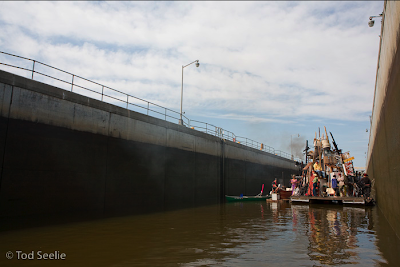
The vessels are imagined as a hybrid between boats and bits of land broken off and headed out to sea. Watching them approach the shore is like seeing a floating city in the distance, as improbable as Venice itself. To the real life crew, the boats are a place of refuge – both a home and a way of moving through the world. To those who encounter the boats for the first time, they are a reminder that anything that can be imagined can be built."
 I'm reminded of the book The Many-Headed Hydra: Sailors, Slaves, Commoners, and the Hidden History of the Revolutionary Atlantic by Peter Linebaugh and Marcus Rediker. This book, published in 2000, is an examination of the Hercules-hydra myth that has long been a tale of imposing order and the battle for power. The authors introduce their writing project by stating:
"From the beginning of English colonial expansion in the seventeenth century through the metropolitan industrialization of the early nineteenth, rulers referred to the Hercules-hydra myth to describe the difficulty of imposing order on increasingly global systems of labor. They variously designated dispossessed commoners, transported felons, indentured servants, religious radicals, urban laborers, soldiers, sailors, and African slaves as the numerous, ever-changing heads of the monster. But the heads, though originally brought into productive combination by their Herculean ruler, soon developed among themselves new forms of cooperation against those rulers, from mutinies and strikes to riots and insurrections and revolution. Like the commodities they produced, their experience circulated with the planetary currents around the Atlantic, often eastward from American plantations, Irish commons, and deep-sea vessel back to the metropoles of Europe.”
 Although not overtly stated, I read the Swimming Cities as a sort of hydra (with many beautiful - American! - heads) that demands a new context for art and, if only for a time, a different way of life. Ahoy maties!


